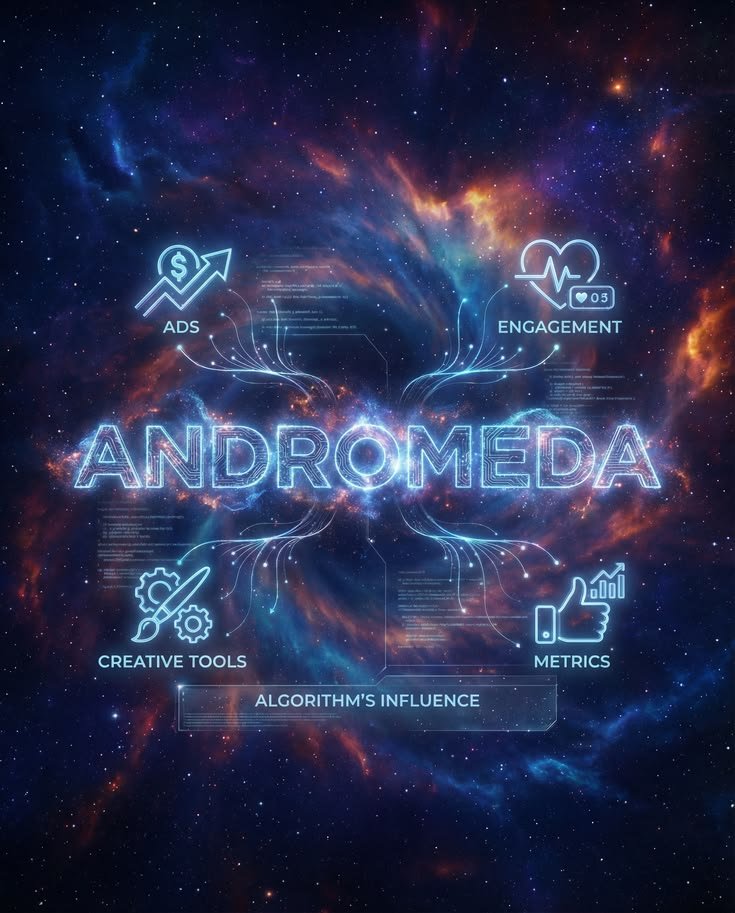
Andromeda is the name commonly used in the digital marketing industry for Meta’s AI-powered advertising recommendation and retrieval system. It is designed to help Meta platforms such as Facebook and Instagram process a huge number of potential ads and identify the most relevant ads for each individual user. Instead of relying only on traditional audience targeting, Meta increasingly uses AI to understand the advertiser’s creative, the user’s interests and behavior, and the context of the ad to determine which ads are worth showing.
How does Andromeda work?
Andromeda works as part of Meta’s broader advertising system. When a person opens Facebook or Instagram, there may be millions of ads that could potentially be shown to them. It would be inefficient to evaluate every ad in detail every time. Andromeda helps retrieve and select relevant advertisements from the enormous pool of available ads.
It can consider signals such as:
User interests and interactions
Previous engagement and browsing behavior
Ad creative and messaging
Product or service relevance
Historical advertising performance
User context
The likelihood that a person will engage with or respond to an ad
The selected ads can then go through Meta’s broader ad ranking and auction systems, which determine what advertisements ultimately appear in a user’s feed.
Why is Andromeda important for digital marketers?
Andromeda represents a major shift in how Meta advertising works. In the past, advertisers often focused heavily on manually selecting detailed audiences, interests, demographics, and behaviors. With AI-driven systems becoming more important, advertisers can increasingly rely on Meta’s algorithms to find potential customers.
This means that creative quality and clear messaging are becoming extremely important.
For example, instead of creating one advertisement and targeting a very narrow audience, a marketer might create several different creatives with different:
Hooks
Headlines
Images
Videos
Offers
Benefits
Calls-to-action
Meta’s systems can then use performance signals to determine which combinations are more likely to work for different people.
Andromeda and ad creatives
One of the biggest lessons for marketers is that creative is increasingly becoming a targeting signal.
Your ad itself communicates information about:
Who the product is for + what problem it solves + why someone should care.
For example, imagine a company selling running shoes.
Instead of creating only:
“Buy our premium running shoes.”
A marketer could create different creatives:
Creative 1:
“Running shoes for beginners who want extra comfort.”
Creative 2:
“Lightweight shoes for long-distance runners.”
Creative 3:
“Affordable running shoes for your daily workout.”
Each creative communicates a different customer need. AI-powered advertising systems can use these signals alongside performance data to find audiences that are more likely to respond.
What does this mean for advertisers?
With AI-driven systems like Andromeda becoming more important, marketers should focus less on over-controlling every small targeting parameter and more on providing Meta’s system with strong inputs.
A modern Meta advertising strategy can focus on:
1. Strong creative
Create high-quality images, videos, Reels, and carousels.
2. Multiple creative variations
Test different hooks, angles, messages, and formats.
3. Clear messaging
Make it immediately obvious what you offer and who it is for.
4. Strong offers
Give people a clear reason to take action.
5. Good landing pages
Make sure the experience after clicking the ad matches the promise made in the advertisement.
6. Quality conversion data
Accurate tracking and conversion signals help Meta’s systems learn which users are valuable.
Andromeda vs traditional targeting
Traditional approach:
Choose audience → Choose interests → Create ad → Run campaign → Optimize manually
AI-driven approach:
Provide strong creative + conversion signals → AI finds relevant users → System learns from results → Continue improving
This doesn’t mean targeting is completely irrelevant. Rather, Meta’s AI systems have become much more important in determining who sees advertisements.
Andromeda and the future of Meta advertising
The growth of AI means digital advertising is becoming increasingly automated. Platforms such as Meta are using machine learning to make decisions about audience selection, ad delivery, creative combinations, and optimization.
For marketers, this changes the role of the advertiser. Instead of spending most of their time manually adjusting dozens of targeting settings, marketers can spend more time on:
Understanding customers
Developing creative concepts
Writing compelling copy
Testing different marketing angles
Building strong offers
Analyzing performance
Improving conversion rates
Simple example
Imagine you are promoting a digital marketing course.
Instead of targeting only:
Age 18–30 + Digital Marketing + Marketing Interests
You could create several ads:
“Learn SEO from beginner to advanced.”
“Start your career in digital marketing.”
“Learn Meta Ads and get your first client.”
“Master digital marketing without a marketing degree.”
These different messages appeal to different motivations. AI-powered systems can use the creative and performance signals to help identify people who are more likely to respond to each message.
In simple words
Andromeda is essentially about using AI to help Meta find and deliver the most relevant advertisements to users from a massive pool of available ads.
For digital marketers, the key takeaway is:
The future of Meta advertising is moving from manual audience targeting toward AI-powered audience discovery, making creative quality, messaging, data, and conversion signals increasingly important.
SEO helps you get found on search engines. AEO helps you become an answer. GEO helps you become visible in generative AI. Andromeda, in contrast, is related specifically to Meta’s AI-driven advertising ecosystem and how ads are selected and delivered.